
 Back to articles




In 2026, sales teams are navigating a crowded landscape of customer relationship management tools, where the right choice can supercharge lead generation or leave you bogged down in inefficiencies. With outbound prospecting demands skyrocketing, many are weighing specialized platforms like ours at GetSales.io against giants such as Salesforce and HubSpot. This article offers a comprehensive guide, comparing CRMs for sales teams: GetSales.io vs. others, to help you make an informed decision. By the end, you'll gain a clear picture of how these options stack up, empowering you to select a CRM that aligns with your team's goals for safe, scalable outreach.
You Will Learn
- The key features that set GetSales.io apart in multichannel automation, LinkedIn safety, and account-based outreach.
- How major CRMs like Salesforce, HubSpot, Pipedrive, Zoho CRM, and Close compare in pricing, usability, performance, and their suitability for B2B outbound.
- Actionable strategies for integrating CRM tools into B2B sales workflows to boost conversions and maintain compliance.
- Common pitfalls in CRM selection and how to avoid them for long-term success and maximum ROI.
- Expert insights on emerging trends in sales automation for 2026, including the rise of AI agents and hybrid CRM stacks.
- Practical tips for scaling outbound efforts while staying compliant with platform policies and data privacy regulations.
Understanding CRM Needs for Modern Sales Teams in 2026
As sales professionals in 2026, you're likely dealing with the intense pressures of high-volume outreach in a multichannel world. The landscape has shifted dramatically; traditional CRMs have evolved, but the rise of specialized tools has made comparing CRMs for sales teams: GetSales.io vs. others more critical than ever. At its core, a strong CRM for sales teams should handle lead management, automation, and analytics seamlessly, especially for B2B organizations focused on aggressive outbound strategies.
Let's start with the basics. According to industry data, the global CRM market is projected to exceed $100 billion by 2026, driven significantly by AI integrations and automation demands Wikipedia on Customer Relationship Management. For sales teams, this means choosing between comprehensive platforms like Salesforce, which dominates with a 20-25% market share, and more niche solutions tailored to specific pain points. The decision isn't just about features; it's about finding a system that truly supports your team's unique workflow and growth ambitions.
GetSales.io, our cloud-based sales automation platform, stands out by emphasizing multichannel lead generation through LinkedIn and email. Unlike broader CRMs that try to be everything to everyone, we focus intensely on scaling outbound prospecting with features like unified inboxes and rotating sender profiles. These innovations help teams manage communications from multiple accounts without risking restrictions, a common headache for high-volume outreach. This is particularly valuable for agencies and B2B firms aiming to personalize at the account level and maintain a consistent, high-impact presence.
In contrast, Salesforce offers enterprise-grade customization with tools like Einstein AI for predictive analytics and advanced reporting. However, its power often comes with a steep learning curve and significant setup time — sometimes 1-6 months for full implementation, requiring dedicated administrators. HubSpot, with its 10-15% market share, shines for small to mid-sized businesses (SMBs) thanks to its free tier and intuitive interface, blending CRM with marketing automation. It's a fantastic all-in-one for inbound-focused teams. Pipedrive keeps things simple with a highly visual, pipeline-focused approach, making it a favorite for teams prioritizing deal flow management. Zoho CRM provides exceptional value through affordable, multi-feature plans that span sales, marketing, and customer service. And then there's Close, which emphasizes outbound calling with built-in dialers and robust communication tracking, ideal for sales teams where phone calls are still king.
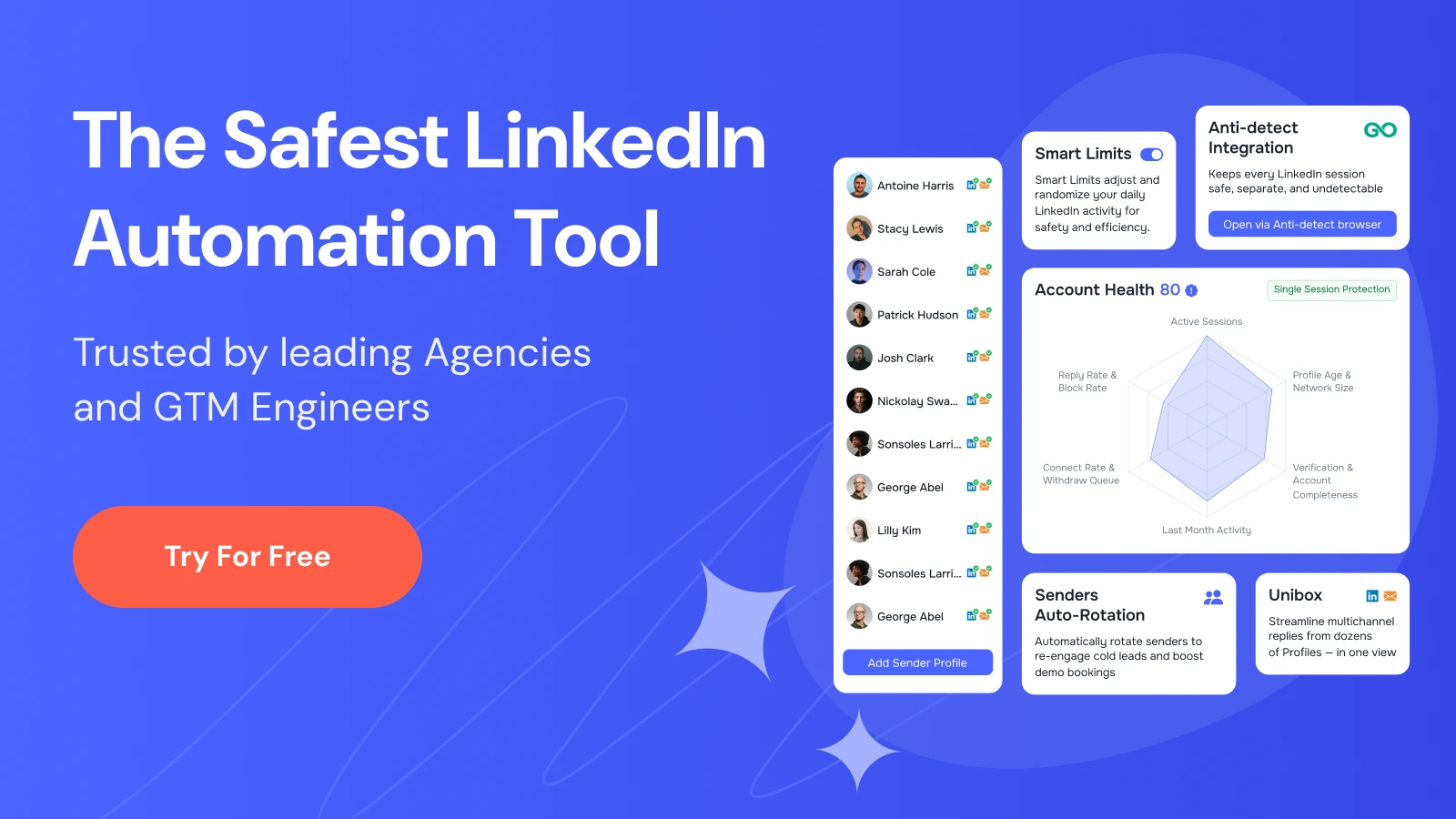
What ties these together, especially in the context of modern outbound sales? The undeniable need for safety in automation. LinkedIn's policies strictly limit automated actions to prevent spam and maintain platform integrity. Guidelines recommend no more than 100-150 connections per week to avoid bans, and exceeding these limits without proper safeguards can lead to severe account restrictions. We at GetSales.io prioritize this with our single session protection and anti-detect browser technology, making us a go-to for teams concerned about account safety and long-term outreach viability. For deeper dives into these safeguards, check out our comprehensive guide on LinkedIn safety.
💡 Tip: When evaluating CRMs, prioritize those with native integrations for your existing tech stack to avoid data silos and streamline workflows. A well-integrated CRM acts as the central nervous system for your sales operations, ensuring data flows freely between your prospecting tools, communication channels, and reporting dashboards.
Statistics show that teams using automated outreach see reply rates increase by 20-30% when personalization is applied effectively. However, not all CRMs deliver this equally. Salesforce's Agentforce AI can autonomously draft and send emails, but it's often overkill for smaller teams or those without a massive budget. HubSpot's Breeze AI, on the other hand, offers prospecting agents that align well with inbound strategies, making it a favorite for content-driven sales. For outbound teams, the challenge is finding a tool that offers both personalization at scale and the safety to execute high-volume campaigns without risking your valuable accounts. This is precisely where a specialized platform like GetSales.io fills a critical gap.
Feature-by-Feature Breakdown: GetSales.io vs. Competitors
Diving deeper into comparisons, let's examine how GetSales.io stacks up against the competition in key areas like automation, safety, analytics, and pricing. This isn't just about bells and whistles — it's about what drives real results for sales teams in 2026, especially when comparing CRMs for sales teams: GetSales.io vs. others for outbound success.
First, consider multichannel lead generation and automation. Our platform at GetSales.io excels here with omni-channel automation, allowing you to build sophisticated sequences across LinkedIn, email, SMS, and more using a no-code builder. This integrates seamlessly with lead enrichment from LinkedIn and Sales Navigator, helping you target high-quality prospects with precision. Imagine crafting a sequence that starts with a LinkedIn connection request, follows up with an email, and then sends a personalized LinkedIn message, all automated yet feeling entirely human. In comparison, Salesforce's Data Cloud federates information for advanced prospecting, but at a higher cost and complexity. HubSpot's sequences tool is user-friendly for email and calls, though it leans more toward inbound follow-ups rather than aggressive, multi-platform outbound initiation. Pipedrive and Zoho offer basic email automation, while Close focuses heavily on integrated dialers for phone-centric outreach.
For LinkedIn and email automation specifically, safety is paramount. GetSales.io's rotating sender profiles and single session protection are designed to drastically reduce ban risks, enabling safe scaling — something we've designed to be 10x safer than many alternatives based on our internal testing and client feedback. This means your team can execute high-volume campaigns with peace of mind, knowing your accounts are protected. Pipedrive and Close offer basic automation, but they lack the depth and specialized safeguards for LinkedIn-heavy workflows. Zoho CRM provides workflows across channels, yet users sometimes report occasional glitches or limitations in high-volume scenarios, especially concerning platform-specific compliance like LinkedIn's.
📌 Note: The "10x safer" claim for GetSales.io is based on our proprietary anti-detection technology and single session protection, which mimics human behavior more closely than traditional automation tools, significantly reducing the footprint that triggers platform security algorithms. This allows for higher volume outreach with a lower risk profile.
Here's a quick table summarizing core features, helping you when comparing CRMs for sales teams: GetSales.io vs. others:
|
Feature Category |
GetSales.io |
Multichannel Automation |
Omni-channel sequences (LinkedIn, email, SMS) with no-code builder, lead enrichment from LinkedIn Sales Navigator. |
Einstein AI for prospecting, email drafting, and sales process automation. |
User-friendly sequences for email and calls; Breeze AI for prospecting and content generation. |
Basic pipelines and emails; Close adds built-in dialers for high-volume calling. Zoho offers cross-channel workflows. |
|
Safety & Compliance |
Single session protection, rotating sender profiles, anti-detect browser for LinkedIn safety (designed to be 10x safer). |
Salesforce Shield for data privacy, compliance, and platform security. |
Operations Hub for data quality and governance; general compliance features. |
Varies; generally limited LinkedIn safeguards; relies on user adherence to platform policies. |
|
Analytics & Insights |
Real-time campaign tracking, account-level analytics, A/B testing, and optimization tools. |
Einstein forecasting, Tableau integration for deep business intelligence, predictive analytics. |
Predictive lead scoring, marketing attribution, sales forecasting, custom reports. |
Visual pipeline reports; Zoho has AI insights and customizable dashboards. Close offers detailed call analytics. |
|
Pricing (Starting) |
$59/month with lifetime options for scalable, outbound-focused plans. |
$25/month (Starter) for basic CRM, scaling to $500+ for enterprise features. |
Free CRM tier; Sales Hub starts at $20/seat/month (Starter), scaling significantly. |
Pipedrive: $14-59/month; Zoho CRM: $14-52/month; Close: $99-499/month. |
|
Best For |
B2B sales teams, agencies, and founders focused on safe, scalable, multichannel outbound (LinkedIn & email). |
Large enterprises needing extensive customization, complex sales processes, and deep analytics. |
SMBs and mid-market companies prioritizing inbound marketing, ease of use, and an all-in-one platform. |
Pipedrive: Simple pipeline management. Zoho: Affordable, comprehensive suite. Close: Outbound calling-heavy teams. |
Data from sources like G2 highlights HubSpot's high user satisfaction (average 4.4/5 rating) for ease of use, while Salesforce scores 4.2/5 due to its immense power but often steep learning curve and complexity G2 CRM Category. GetSales.io, as a specialized tool, earns praise for its affordability, outbound focus, and robust safety features, though it's not as broadly reviewed on general CRM platforms due to its niche.
Integration capabilities also matter immensely. We offer third-party connections to enhance workflows, much like HubSpot's extensive app marketplace. However, Salesforce leads in enterprise scalability with industry-specific clouds and a vast ecosystem of integrations. For sales teams in IT or software firms, this means weighing cost against depth — GetSales.io often wins for budget-conscious groups scaling safely, especially when paired with a more general CRM for pipeline management.
⚠️ Warning: Over-relying on automation without human oversight can violate regulations like GDPR or CCPA, leading to significant fines. Always ensure consent-based outreach, provide clear opt-out options, and maintain accurate records of communication to stay compliant. Your CRM should support these efforts, not hinder them.
Recent news in 2026 points to AI agents as a game-changer, with Salesforce's Agentforce reducing manual work by 40-50% in lead qualification. Yet, for outbound-heavy teams, combining GetSales.io with a CRM like HubSpot creates a powerful hybrid stack that maximizes ROI without the enterprise overhead. This approach allows teams to leverage GetSales.io's specialized outbound capabilities for safe, high-volume prospecting, while using HubSpot for broader CRM functions, marketing automation, and pipeline management. It's a smart way to get the best of both worlds.
Best Practices for Scaling Sales with CRMs
Implementing a CRM effectively requires more than just signing up — it's about aligning it with your B2B sales techniques and strategic goals. Here are actionable steps to get started and ensure you're maximizing your investment, especially when comparing CRMs for sales teams: GetSales.io vs. others for optimal performance.
- Assess Your Needs Thoroughly: Before committing, take a deep dive into your team's size, sales cycle, target audience, and primary outreach channels. For high-volume outbound, prioritize tools like GetSales.io with robust LinkedIn import and enrichment capabilities to build highly targeted lists. If inbound leads are your bread and butter, HubSpot might be a better fit. Don't just look at features; consider your team's existing tech stack and comfort level with new tools.
- Set Up Automation Workflows Strategically: Use no-code builders to create drip campaigns, A/B tests, and multi-step sequences. Start with personalized messaging — industry benchmarks show this boosts engagement by 25% compared to generic blasts. Leverage your CRM's automation to handle initial outreach, follow-ups, and lead nurturing, freeing up your sales reps for high-value conversations.
- Integrate Analytics for Continuous Optimization: Track key metrics like open rates, reply rates, conversion rates, and pipeline velocity in real time. Tools with account-level insights, like ours, help you identify what's working and what's not, allowing you to optimize strategies quickly. Regular review of your CRM's dashboards and reports is crucial for data-driven decision-making.
- Ensure Compliance and Account Safety: This is non-negotiable. Follow LinkedIn's guidelines by incorporating intelligent delays and limits into your automation sequences. Our platform's single session protection and rotating sender profiles make this effortless, significantly reducing the risk of account bans. Always prioritize ethical outreach and respect privacy regulations like GDPR and CCPA.
- Invest in Comprehensive Team Training: A CRM is only as good as its adoption rate. Invest in thorough onboarding and ongoing training to maximize user adoption and ensure your team is leveraging all relevant features. For example, our SDR CRM with tasks ensures no lead slips through the cracks and helps standardize best practices across your sales force.
Professional advice from experts often emphasizes hybrid approaches: Pair a full-featured CRM like Zoho for comprehensive pipeline management and reporting with a specialized tool like GetSales.io for targeted, safe outbound outreach. This is especially useful for VPs of Business Development at enterprise firms looking to reduce costs while scaling their prospecting efforts without compromising on safety or effectiveness.
For founders of lead generation agencies, cost-effectiveness and demonstrable ROI are key. Our plans starting at $59 per month provide multi-channel capabilities without the bloat of enterprise systems, helping maximize client conversions safely and efficiently. This allows agencies to offer cutting-edge outbound services without prohibitive software costs.
📌 Note: In 2026, AI-driven personalization is non-negotiable. Tools without the ability to dynamically tailor messages based on prospect data risk falling behind in competitive B2B landscapes. Look for CRMs that offer AI-powered insights and content generation to truly stand out.
Common Mistakes to Avoid in CRM Selection
Choosing the wrong CRM can derail your sales efforts, leading to wasted time, budget, and missed opportunities. Let's highlight common pitfalls based on real-world feedback and industry observations, crucial insights when comparing CRMs for sales teams: GetSales.io vs. others.
One major error is overlooking scalability. Teams often start with free options like HubSpot's basic CRM but quickly outgrow them, facing escalating costs and feature limitations as their needs evolve. Conversely, jumping into a complex system like Salesforce without proper planning and resources often leads to underutilization — studies show 30% of features go unused in complex setups, representing significant wasted investment Forbes on CRM Trends. Always project your growth for the next 3-5 years and choose a CRM that can comfortably scale with you.
Another critical mistake is ignoring safety in automation. High ban rates plague tools without robust protections, disrupting campaigns and potentially damaging your brand's reputation. Many generic automation tools lack the sophisticated anti-detection and single session protection that GetSales.io offers, leaving your valuable LinkedIn accounts vulnerable. Always verify a tool's compliance features with platform policies like those from LinkedIn before integrating it into your workflow.
Failing to integrate with existing systems creates data silos, reduces efficiency, and frustrates sales reps who have to manually transfer information. Your CRM should be the central hub, not an isolated island. Prioritize CRMs with open APIs and a wide range of native integrations to ensure seamless data flow across your entire tech stack.
And don't forget user training and adoption — poor adoption can tank ROI faster than any other factor. A powerful CRM is useless if your team doesn't know how to use it or finds it too cumbersome. Look for intuitive interfaces and ensure you allocate resources for comprehensive training and ongoing support.
Finally, chasing shiny features over core needs is a common trap. While AI and advanced analytics are exciting, focus on what truly drives your outbound prospecting and sales process. For many B2B teams, this means reliable multichannel outreach, lead enrichment, and robust safety features like our identity renting for expanded reach. Don't get distracted by features you won't use.
💡 Tip: Conduct a trial period with multiple CRMs to test their real-world fit before committing to a long-term contract. Pay attention to ease of use, integration capabilities, and how well the support team responds to your queries. This hands-on experience is invaluable for making an informed decision.
Expert Insights and Real-World Examples
Industry leaders offer valuable perspectives on CRM choices, especially when comparing CRMs for sales teams: GetSales.io vs. others. As one expert notes, "Salesforce wins for complex, enterprise-grade CRM needs, offering unparalleled customization and a vast ecosystem. HubSpot, on the other hand, excels for teams wanting powerful features without the enterprise overhead, particularly those with strong inbound marketing strategies" (from a 2026 VantagePoint analysis).
Frédéric D, Co-founder of MirrorProfiles, a leading sales agency, shares his direct experience: "GetSales.io is hands down the safest and most reliable option we've tested for LinkedIn outreach. Its single session protection and anti-detect features make it 10x safer than others we've tried, allowing us to scale client campaigns with confidence and zero account issues." This testimonial underscores the critical importance of safety in today's aggressive outbound environment.
In a real-world case study, a B2B software firm struggling with LinkedIn account bans and inconsistent outreach switched to a hybrid stack: GetSales.io integrated with HubSpot. By leveraging GetSales.io for safe, multichannel prospecting and HubSpot for lead nurturing and pipeline management, they scaled their qualified leads by 40% within six months while cutting ban incidents to zero. This demonstrates the power of combining specialized tools for specific functions.
Another example: An enterprise agency using Salesforce's Agentforce successfully automated a significant portion of their lead qualification process, boosting closed deals by 15% through AI-driven insights. However, this came at a higher cost and required dedicated resources for setup and maintenance — highlighting why hybrid solutions often provide a better ROI for many organizations.
Trends in 2026 clearly show hybrid stacks rising, with specialized tools like ours filling critical gaps in outbound safety and efficiency that broader CRMs might overlook Capterra CRM Insights. This approach allows businesses to tailor their tech stack precisely to their needs, rather than trying to force a single platform to do everything.
For GTM (Go-to-Market) engineers prioritizing stability and robust performance, our advanced API and bug-free automation stand out. We understand that reliable infrastructure is key to consistent outreach and data integrity, making GetSales.io a trusted partner for technical sales operations.
FAQ
What makes GetSales.io different from Salesforce or HubSpot? GetSales.io specializes in safe, multichannel outbound automation for LinkedIn and email, with unique features like rotating sender profiles and single session protection to prevent account bans. Salesforce and HubSpot offer broader CRM ecosystems focused on enterprise customization and inbound marketing, respectively, with less emphasis on specialized outbound safety.
How do pricing models compare across these CRMs? GetSales.io starts at $59/month for scalable plans, offering strong value for outbound-focused teams. Salesforce begins at $25/month but scales rapidly to $500+ for advanced features. HubSpot has a free CRM tier but charges $20/seat/month upward for Sales Hub. Others like Pipedrive and Zoho CRM are typically $14-59/month, while Close is higher at $99-499/month due to its built-in dialers.
Is LinkedIn automation safe in 2026? Yes, if done correctly and with the right tools. It's crucial to follow LinkedIn's guidelines limiting actions and use platforms with advanced safety features like GetSales.io's single session protection and anti-detect browser technology to minimize the risk of account restrictions or bans. Ethical and human-like automation is key.
Which CRM is best for small sales teams? For simplicity and affordability, HubSpot's free CRM or Pipedrive are excellent starting points. However, for small teams focused on scaling outbound lead generation, adding a specialized tool like GetSales.io for safe LinkedIn and email outreach can significantly boost their effectiveness without the enterprise overhead.
How can I integrate CRMs for better lead generation? Leverage native integrations or APIs to connect your CRM with prospecting tools. For example, you can pair GetSales.io's lead enrichment and outbound automation with HubSpot's analytics and pipeline management for targeted campaigns, seamless data flow, and comprehensive reporting. This creates a powerful hybrid stack.
What regulations should sales teams consider in 2026? Sales teams must adhere to data privacy regulations such as GDPR (General Data Protection Regulation) and CCPA (California Consumer Privacy Act). This means ensuring consent-based data handling, providing clear opt-out mechanisms, and maintaining transparent communication practices. Your CRM should support compliance features and help you manage prospect data responsibly.
Ready to Scale Your Sales Outreach?
If you're ready to transform your lead generation with safe, automated strategies and stop settling for average, it's time to explore GetSales.io today. Our platform is built specifically for sales teams like yours, offering the cutting-edge tools to personalize and scale your outreach without the risks associated with generic automation. Don't just read about it, see it in action! Schedule a personalized demo at this link or visit getsales.io to get started. Let's work together to 10x your outreach in 2026 and achieve your ambitious sales goals.