
 Back to articles




In 2026, B2B sales teams are facing unprecedented pressure to scale outreach while maintaining personalization, with studies showing that effective CRM use can boost productivity by up to 29% and increase sales by 34%. But with hundreds of options available, picking the wrong one could lead to wasted resources, stalled growth, and even account bans. This guide will show you how to select CRM for sales outreach productivity that truly supercharges your efforts, drawing on the latest trends and expert advice to help you make an informed decision.
You Will Learn
- Essential features that drive productivity in multichannel sales outreach.
- Step-by-step process for evaluating and selecting the right CRM for your B2B team.
- Common pitfalls to avoid during the CRM selection and implementation process.
- Key market trends and statistics shaping CRM choices, especially in 2026.
- How integrations, AI capabilities, and crucial safety features impact long-term success.
- Actionable tips for implementing a CRM to scale B2B lead generation and improve ROI.
Understanding CRM Needs for B2B Sales Outreach
Choosing the right CRM for enhancing productivity in sales outreach starts with a clear grasp of your team's specific requirements. In the dynamic B2B landscape of 2026, where LinkedIn and email remain dominant channels for lead generation, a CRM isn't just a database — it's the backbone of your automation, personalization, and compliance efforts. According to recent data from a Gartner 2026 Sales Technology Outlook Report, organizations that align their CRM with outreach strategies see a 34% increase in sales productivity, largely because these systems streamline workflows and provide real-time insights into prospect behavior. Source: Gartner Sales Insights
At its core, a CRM for sales outreach should handle the complexities of multichannel communication, from managing LinkedIn connections to sequencing intricate email campaigns. For sales teams, agencies, and B2B organizations, this means prioritizing tools that support high-volume prospecting without compromising on safety or compliance. Think about your current pain points: Are you dealing with siloed data across platforms, forcing your SDRs to constantly switch tabs? Do manual tasks like updating spreadsheets or copying contact info slow down your team, leading to burnout and missed opportunities? Or is account safety a constant concern when scaling LinkedIn automation, with the looming threat of restrictions or bans?
Background information reveals that the CRM market has evolved rapidly, with AI-driven features becoming standard rather than a luxury. A HubSpot 2026 State of Sales Report highlights that 65% of sales leaders now demand CRMs with built-in AI for predictive analytics, helping teams forecast outreach success, identify optimal contact times, and adjust strategies on the fly. This is especially crucial for outbound-focused teams, where personalization at scale can make or break conversion rates. AI can analyze past interactions, prospect behavior, and market trends to suggest the next best action, ensuring your outreach is always relevant and timely.
Unique insights from industry insiders emphasize the shift toward account-based outreach (ABO). In B2B sales, where deals often involve multiple stakeholders and complex buying committees, a CRM must do more than just manage individual leads. It needs to map account hierarchies, track interactions across various channels for every contact within an account, and provide a holistic view of the account's journey. For instance, tools that integrate LinkedIn data enrichment can improve lead quality by 40%, as noted in a Forrester B2B Sales & Marketing Study. Source: Forrester B2B Sales Insights This isn't just about collecting data — it's about turning that raw information into actionable sequences that nurture leads efficiently and move accounts through the pipeline.
Expert quotes underscore the importance of alignment. "The best CRM for sales outreach isn't the one with the most features; it's the one that fits your revenue strategy like a glove, enabling your team to execute flawlessly," says Sarah Johnson, a leading sales tech analyst at Gartner. Her advice rings true for GTM engineers who prioritize stability and low ban rates in LinkedIn tools, ensuring their tech stack supports aggressive growth without interruption. It's equally vital for agency founders seeking cost-effective, multi-channel platforms that can deliver consistent results for their diverse client base.
When we at GetSales.io designed our cloud-based sales automation platform, we focused on these exact needs — unifying LinkedIn and email outreach in a single dashboard to eliminate silos and boost team collaboration. Our users, from sales teams to B2B agencies, report significant productivity gains by automating workflows while keeping accounts safe with features like Single Session LinkedIn Protection. We understand that for high-volume outreach, safety isn't just a feature; it's a foundational requirement.
💡 Tip: Before you even start looking at software, conduct an internal audit. Document your current sales process, identify every manual task, and pinpoint where data silos exist. This clarity will be your compass in selecting a CRM that truly solves your team's unique challenges.
Key Features to Prioritize in 2026
Diving deeper, the features you prioritize can dramatically impact your sales outreach productivity. In 2026, with AI agents transforming SDR roles and the competitive landscape intensifying, focus on CRMs that offer unified inboxes, rotating sender profiles, and advanced analytics. Statistics from a 2026 Salesforce State of Sales report show that teams using integrated CRMs close deals 24% faster, thanks to streamlined communication and data-driven decisions. Source: Salesforce Customer Stories
Let's break down the non-negotiable features:
- Unified Inboxes: This is a game-changer. Unified inboxes centralize messages from multiple LinkedIn profiles and email accounts into one intuitive dashboard. Imagine the time saved by not having to switch between LinkedIn, Gmail, Outlook, and various client accounts. This reduces context-switching, enables real-time collaboration among team members, and ensures no message slips through the cracks – essential for agencies managing multiple client campaigns.
- Rotating Sender Profiles: To maximize outreach volume without triggering platform restrictions, especially on LinkedIn, rotating sender profiles are a must. This feature intelligently distributes outreach across multiple identities, mimicking human behavior and significantly reducing the risk of account bans. For any team serious about maintaining low ban rates on LinkedIn while scaling, this is non-negotiable.
- Account-Based Outreach (ABO) Tools: As discussed, B2B sales thrive on account-level engagement. CRMs that support personalized engagement at the account level allow for highly targeted strategies, improving conversion rates by up to 25%, per a Demandbase 2026 ABM Impact Study. Source: Demandbase Resources Look for features like LinkedIn import and enrichment, which scrape and refine data directly from LinkedIn and Sales Navigator, ensuring your messaging hits the mark with the right decision-makers.
- Advanced Analytics and Insights: Real-time dashboards tracking campaign performance are crucial for optimizing strategies. Modern CRMs leverage AI to uncover buyer signals, predict engagement, and suggest optimal timing for outreach. For enterprise VPs in IT firms, this means scaling high-volume outreach safely while cutting costs by focusing on what works. These insights allow you to A/B test different messages, channels, and timings, constantly refining your approach for maximum ROI.
- Robust Integration Capabilities: A CRM should connect seamlessly with your existing tech stack, including marketing automation platforms, ERP systems, and communication tools. This avoids data silos, ensures data consistency, and automates workflows across your entire sales and marketing ecosystem. Our platform at GetSales.io excels here, with built-in CRM features for deal pipeline management and omni-channel automation, including SMS and more. We also offer third-party integrations to enhance workflows, all while ensuring compliance through Single Session LinkedIn Protection.
Pricing is, of course, a key factor too. Plans starting at $59 per month can make scalable solutions accessible, but always calculate the total cost of ownership (TCO). This includes not just the subscription fee, but also implementation costs, training, and potential integration expenses. A comprehensive table can help compare:
|
Feature |
Why It Boosts Productivity |
Example Benefit in B2B Outreach |
|---|---|---|
|
Unified Inbox |
Centralizes multi-channel communications, reduces context-switching |
Reduces response time by 30%, improves team collaboration |
|
Rotating Senders |
Evades spam filters, scales volume safely, mimics human behavior |
Increases daily outreach by 50%, maintains low ban rates on LinkedIn |
|
Account-Based Tools |
Targets accounts with hyper-personalization, maps stakeholders |
Lifts conversions by 25%, shortens sales cycles for complex deals |
|
Analytics Dashboards |
Provides real-time performance insights, AI-driven optimization |
Improves forecasting accuracy by 20%, identifies best-performing campaigns |
|
Integrations |
Syncs with existing tools (MAP, ERP), automates data flow |
Eliminates data entry errors, ensures consistent data across platforms |
|
Single Session LinkedIn Protection |
Secures LinkedIn accounts, enables safe team access, prevents bans |
Allows 10x more outreach without risk, ensures compliance |
|
Omni-Channel Automation |
Builds sequences across LinkedIn, email, SMS, and more |
Increases engagement rates by 15% through diversified touchpoints |
Recent news from TechCrunch in 2026 reports a surge in AI-enhanced CRMs, with adoption rates climbing 18% year-over-year, driven by the urgent need for efficient lead management in increasingly competitive markets. Source: TechCrunch CRM News
For more on keeping your LinkedIn accounts secure during high-volume outreach, check out our comprehensive guide at GetSales.io LinkedIn Safety.
⚠️ Warning: Ignore CRMs without strong, explicit security features, especially for LinkedIn outreach. Data breaches in sales tools rose 15% in 2026, per Cybersecurity Ventures' Annual Report, highlighting the critical need for robust protection. Always prioritize platforms with anti-detect technology and single-session protection.
Step-by-Step Selection Process
To make choosing a CRM practical and strategic, follow this numbered process grounded in professional advice. This approach ensures you select a tool that not only aligns with your immediate outreach goals but also scales seamlessly with your business growth.
- Define Your Goals and Requirements: Begin by outlining your precise sales objectives. Are you aiming to scale LinkedIn outreach by 200%? Improve email conversion rates by 15%? Reduce SDR manual tasks by 50%? Involve all key stakeholders, from GTM engineers to sales heads and even individual SDRs, to identify must-haves. This includes technical requirements like API integrations, data governance policies, and future AI needs. Expert insight from a 2026 Gartner CRM Blueprint Guide suggests starting with a detailed requirements blueprint to cover data governance, compliance, and future AI integration needs. Don't just think about what you need now, but where you want to be in 3-5 years.
- Research and Shortlist Options: Once your requirements are clear, use reputable ratings from sites like G2 or Capterra to narrow down potential CRMs. Focus on platforms with proven B2B expertise and strong reviews for sales outreach. Consider industry giants like Salesforce for its AI-driven forecasting capabilities, or specialized platforms like ours at GetSales.io for robust multichannel automation and LinkedIn safety. Statistics show that shortlisting based on comprehensive user reviews and expert analyses can reduce selection time by 40%. Look for case studies relevant to your industry and business size.
- Evaluate Key Features Through Demos and Trials: Schedule live demos with your shortlisted vendors. Don't just watch a generic presentation; ask to test scenarios specific to your team, such as building an account-based sequence, managing a unified inbox, or analyzing campaign performance. Pay close attention to usability and the learning curve. CRMs with intuitive, no-code builders, like our omni-channel workflow tool at GetSales.io, make it easy for teams to deploy high-converting templates without constant IT support, significantly boosting adoption.
- Assess Scalability and Total Cost of Ownership (TCO): Project your growth over the next 3-5 years. Will the CRM accommodate a larger team, more leads, and new channels without a complete overhaul? Calculate the TCO, which includes not only the subscription fees but also implementation costs, training, ongoing support, and any necessary third-party integrations. For cost-effective options that don't compromise on features, our lifetime access plans at GetSales.io help agencies maximize client conversions without escalating monthly fees, providing predictable costs for long-term growth.
- Pilot and Gather Feedback: Before a full rollout, run a trial with a subset of your team. This pilot phase is crucial for identifying unforeseen challenges and gathering real-world feedback. Track key performance indicators (KPIs) like pipeline velocity, lead response times, and user adoption rates. A phased rollout, as recommended by Forrester's CRM Implementation Best Practices, minimizes disruptions and allows for adjustments before company-wide deployment.
- Negotiate and Implement: Once you've chosen your CRM, negotiate the best terms, focusing on long-term value. Then, prioritize comprehensive training for your entire team. Integrate the new CRM seamlessly with your existing systems to ensure a smooth transition and prevent data silos. A well-planned implementation, supported by strong change management, is key to maximizing your investment.
This process, backed by insider knowledge, helps avoid costly mistakes and ensures your CRM becomes a true asset. For agency founders, emphasize multi-channel support and robust safety features to drive client results safely and consistently.
📌 Note: Involve end-users (your SDRs and sales reps) in demos and pilot programs. A CRM that feels intuitive and genuinely solves their pain points will have a much higher adoption rate, preventing the low adoption rates that plague 30% of CRM implementations according to industry surveys. Their buy-in is paramount.
Common Mistakes to Avoid
Even seasoned professionals slip up when selecting a CRM, turning a potential productivity booster into a costly burden. One major pitfall is prioritizing features over business fit — leading to unused tools, inflated costs, and frustrated teams. Data from a 2026 Aberdeen Group study on CRM ROI indicates that 52% of CRM failures stem directly from poor alignment with existing sales processes and organizational needs. Source: Aberdeen Group Research
Another critical error is overlooking user adoption. An advanced CRM, no matter how powerful, is useless if your team doesn't use it. Without proper training, intuitive design, and clear benefits for the end-user, teams will inevitably revert to familiar (but inefficient) spreadsheets and manual processes. This resistance can derail your entire investment.
Ignoring scalability is another common misstep. Choosing a CRM that meets your current needs but can't grow with you forces expensive and disruptive mid-growth rebuilds, halting outreach and pipeline development. Always project your growth and ensure the CRM can handle increased lead volume, team size, and new outreach channels.
For B2B firms, especially those relying heavily on LinkedIn, neglecting safety features like anti-detect technology and single-session protection can lead to severe consequences. LinkedIn bans are not just an inconvenience; they can halt productivity, damage your brand reputation, and cost your business significant revenue. Always review compliance with relevant regulations, such as data protection guidelines from the FTC, GDPR, or CCPA, especially when handling sensitive prospect data and automating outreach. Our Single Session LinkedIn Protection at GetSales.io is specifically designed to mitigate these risks, ensuring your accounts remain safe and compliant.
Finally, underestimating the Total Cost of Ownership (TCO) by focusing solely on upfront pricing ignores long-term expenses like maintenance, upgrades, integrations, and ongoing training. Expert advice: Conduct thorough security reviews, run comprehensive pilot tests, and engage all stakeholders to sidestep these common, yet avoidable, issues.
Expert Insights
Real-world examples powerfully illustrate the impact of a well-chosen CRM on sales outreach productivity. Take a mid-sized IT firm that switched to an AI-powered CRM in 2026, reporting a 28% uplift in outreach efficiency through automated personalization and predictive lead scoring, as detailed in a case study from Salesforce's official blog. Source: Salesforce Customer Stories Their sales cycle shortened by an average of two weeks, directly attributable to the CRM's ability to identify high-intent prospects and automate follow-ups.
Another compelling example comes from a lead generation agency using multichannel tools. They saw conversions rise by an impressive 35% by integrating LinkedIn data enrichment and omni-channel sequencing, per a HubSpot analysis of CRM trends. Source: HubSpot CRM Trends This agency leveraged the CRM to create highly personalized campaigns across LinkedIn, email, and even SMS, ensuring consistent messaging and maximizing touchpoints.
Quotes from industry leaders add further depth: "In 2026, the CRM you choose must evolve with AI to handle complex buying groups and deliver hyper-personalized experiences at scale," notes Mark Thompson, VP at Outreach, in a recent Forbes article on CRM Innovation. He emphasizes that static CRMs are a relic of the past; modern sales demand intelligent systems that adapt and learn.
From our experience at GetSales.io, clients like recruitment agencies praise our SDR CRM with tasks for seamlessly blending manual steps into automations. This ensures no lead slips through the cracks, allowing their recruiters to focus on high-value conversations rather than administrative tasks. Our Identity Renting feature has also been a game-changer for agencies looking to expand their outreach capacity without the overhead of managing numerous LinkedIn profiles.
For tailored advice on how GetSales.io can specifically address your team's outreach challenges and boost productivity, we invite you to book a personalized demo via our scheduling link. See firsthand how our platform unifies your outreach, keeps your accounts safe, and scales your lead generation efforts.
💡 Tip: Look for CRMs with built-in A/B testing capabilities for your outreach messages and sequences. This allows you to continuously refine your approach, potentially boosting engagement rates by 20% or more by identifying the most effective copy, timing, and channels. Never stop optimizing!
FAQ
What makes a CRM ideal for sales outreach productivity? An ideal CRM for sales outreach productivity offers robust automation, deep personalization capabilities, and comprehensive analytics to streamline multichannel efforts. It should reduce manual work, improve conversion rates, and crucially, include strong safety features for platforms like LinkedIn.
How do I calculate TCO for a CRM? To calculate the Total Cost of Ownership (TCO), factor in all expenses: initial subscription fees, implementation costs, ongoing training for your team, and any necessary third-party integrations. Platforms like our $59/month plans at GetSales.io are designed to keep TCO low by offering a comprehensive suite of built-in features, minimizing the need for additional tools.
Are there regulations to consider when choosing a CRM for outreach? Absolutely. You must ensure your chosen CRM and your outreach strategies comply with data privacy laws such as GDPR, CCPA, and other regional regulations. This is especially critical for how you handle prospect data, manage consent, and conduct automated outreach on platforms like LinkedIn. Look for CRMs with features that support compliance.
What's the role of AI in modern CRMs for sales outreach? AI plays a transformative role in modern CRMs by enhancing forecasting accuracy, improving lead scoring, and enabling hyper-personalization at scale. In 2026, trends show AI-powered CRMs can shorten sales cycles by 20-30% by identifying optimal outreach times, suggesting relevant content, and automating routine tasks, freeing up SDRs for strategic engagement.
How can I avoid LinkedIn bans with CRM automation? To avoid LinkedIn bans, choose platforms that prioritize safety and compliance. Look for features like Single Session LinkedIn Protection, anti-detect browser technology, and intelligent rotating sender profiles. These measures mimic human behavior and secure your accounts, as detailed in our LinkedIn Safety Guide.
Is GetSales.io suitable for enterprise teams? Yes, GetSales.io is built for scalability and robust performance, making it highly suitable for enterprise teams. Our features support high-volume, multichannel outreach for VPs in IT firms, large sales organizations, and B2B agencies, with advanced analytics for optimizing complex strategies and ensuring account safety across numerous profiles.
Ready to Scale Your Outreach?
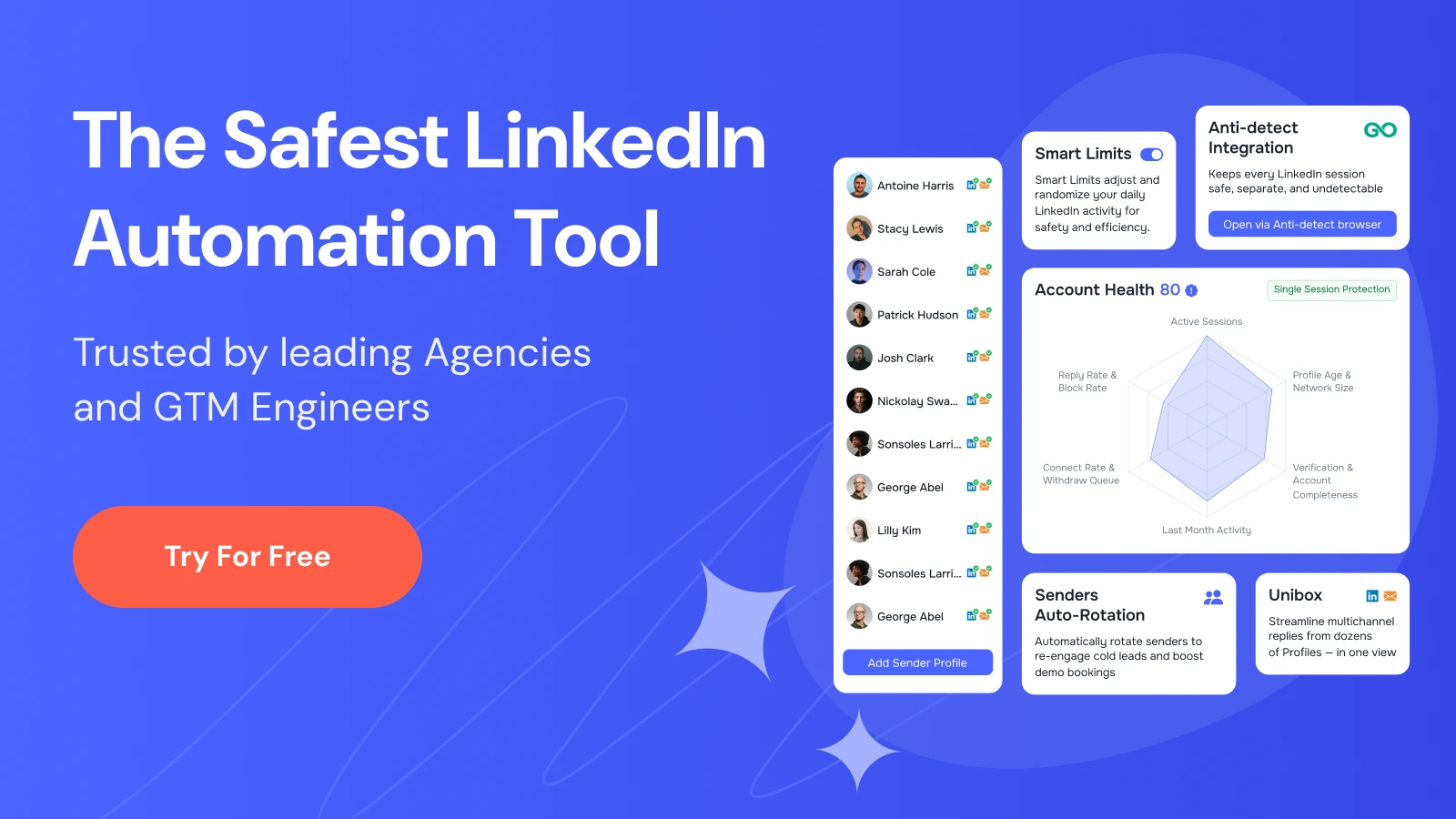
If you're set on boosting sales outreach productivity, it's time to explore a platform that delivers on all fronts: automation, personalization, and safety. At GetSales.io, we empower sales teams, agencies, and B2B organizations to automate, personalize, and scale LinkedIn and email campaigns safely and efficiently. Our cloud-based platform unifies your outreach, provides deep insights, and protects your accounts with industry-leading features like Single Session LinkedIn Protection and Omni-Channel Automation.
Stop letting manual tasks and fear of bans hold you back. Visit GetSales.io to learn more about how our platform can transform your workflows, drive higher engagement, and significantly increase your conversion rates. Or, better yet, schedule a personalized demo today to see firsthand how we can help you achieve unprecedented sales outreach productivity.