
 Back to articles




Did you know that integrating LinkedIn and email can boost B2B response rates by up to 45% compared to single-channel approaches? In this article, we'll compare LinkedIn and email automation for lead generation, highlighting pros, cons, best practices, and how our platform at GetSales.io empowers founders of lead generation agencies to scale multichannel outreach safely and cost-effectively. Drawing from recent data and expert insights, we'll explore integration benefits, regulations, and actionable strategies to maximize conversions.
Why Compare LinkedIn and Email for Lead Generation?
LinkedIn excels in building trust with high-intent prospects, boasting average reply rates of 20-45% for well-targeted InMail, while email shines in scalability with low costs but lower cold reply rates of 1-3% (source: HubSpot's 2024 State of Marketing Report). Our comparison reveals that a multichannel strategy often yields the highest ROI, combining LinkedIn's precision targeting with email's automation power.
Key Stats at a Glance:
- LinkedIn generates 3x more leads from organic content than email newsletters (source: LinkedIn's B2B Marketing Benchmark).
- Email campaigns achieve 35-60% open rates on targeted lists, but LinkedIn offers superior lead quality due to rich profile data (source: Mailchimp's Email Marketing Benchmarks).
- Multichannel sequences lift meeting-booked rates to 2-8% versus single-channel baselines (source: Salesloft's State of Sales Report).
For agency founders, understanding this LinkedIn and email automation for lead generation comparison helps select tools that reduce ban risks and enhance client results.
Pros and Cons of LinkedIn Automation
LinkedIn automation streamlines B2B prospecting but requires careful handling to avoid platform restrictions.
Pros:
- High engagement: Personalized outreach yields 20-45% reply rates, far surpassing email (source: LinkedIn).
- Precise targeting: Filter by job title, industry, and seniority for account-based strategies.
- Trust-building: Prospects view your profile and mutual connections, accelerating credibility.
Cons:
- Account risks: Aggressive automation can lead to bans; LinkedIn prohibits unauthorized bots (source: LinkedIn User Agreement).
- Limits on scale: Daily caps restrict high-volume outreach.
- Higher costs: Tools like Sales Navigator add expenses.
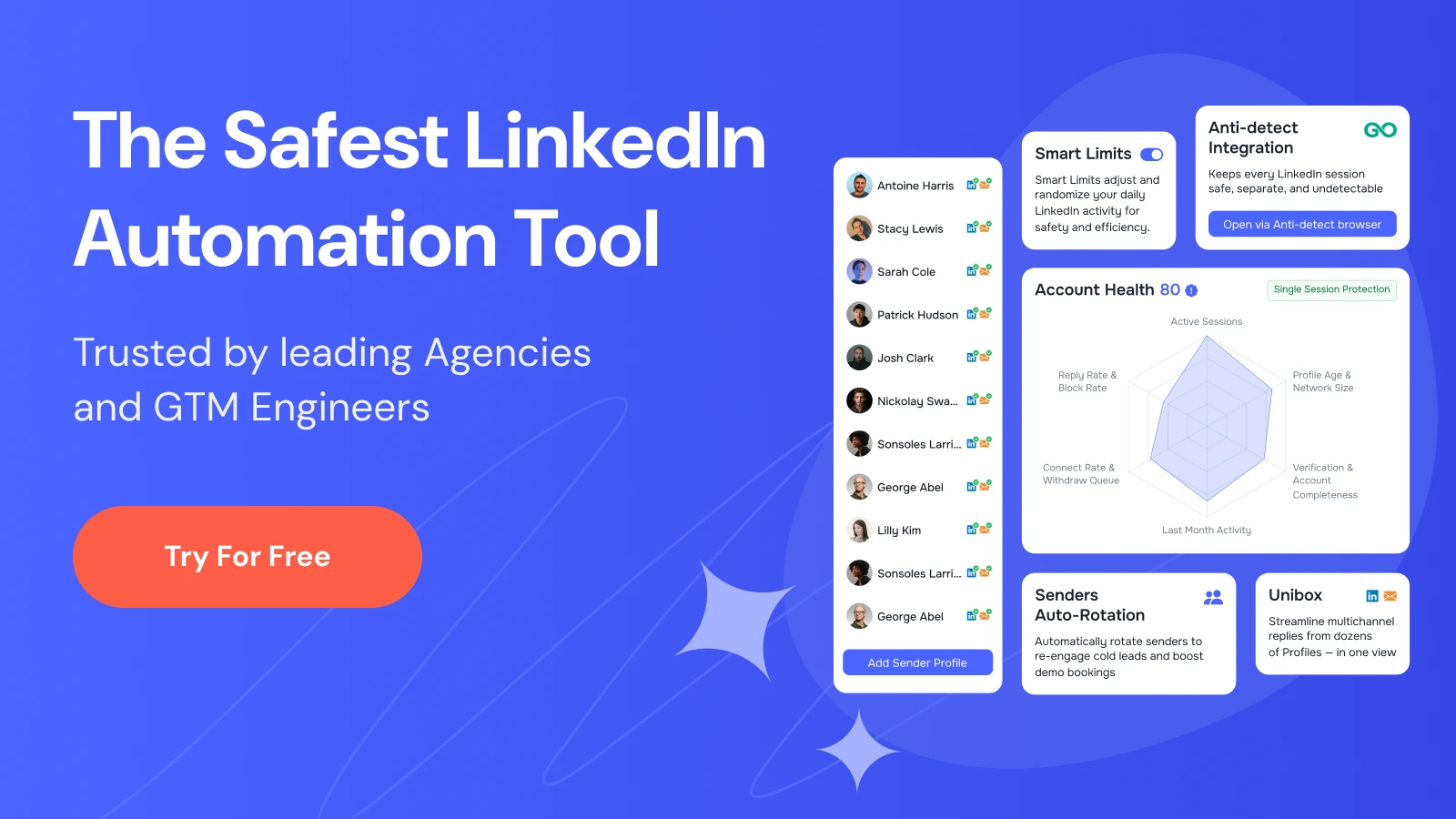
At GetSales.io, our Single Session LinkedIn Protection ensures 10x safer automation, minimizing bans while scaling efforts — explore more at LinkedIn Safety.
Pros and Cons of Email Automation
Email automation enables massive reach but demands compliance and list quality.
Pros:
- Scalability: Reach thousands at low marginal cost with 3-8% reply rates in optimized campaigns.
- Advanced workflows: Use drip campaigns and triggers for nurturing.
- Owned asset: Unlike LinkedIn, your list isn't platform-dependent.
Cons:
- Deliverability challenges: Spam filters and low engagement hurt performance.
- Regulatory hurdles: Violating CAN-SPAM can result in penalties (source: FTC CAN-SPAM Rule).
- Lower trust: Cold emails often see suspicion, with 1-3% baseline replies.
Our platform integrates email with LinkedIn for seamless sequences, boosting deliverability through Rotating Sender Profiles.
Benefits of Multichannel Integration
The real power lies in combining channels: Use LinkedIn for warming (e.g., profile views and connections) and email for follow-ups, increasing overall engagement by 4x via personalized video touches (source: Vidyard's Video in Business Benchmark Report).
Integration Advantages:
- Higher ROI: Multichannel cadences convert better than isolated efforts.
- Data synergy: Enrich emails with LinkedIn insights for hyper-personalization.
- Risk reduction: Distribute outreach to avoid over-relying on one platform.
Expert quote: "LinkedIn to start, email to scale is the dominant B2B pattern," notes sales strategist John Barrows (source: John Barrows Blog).
With our Omni-Channel Automation, agencies automate these flows effortlessly — schedule a demo at Book a Meeting.
Best Practices for Safe and Effective Automation
Follow these guidelines to optimize your LinkedIn and email automation for lead generation comparison strategy.
For LinkedIn:
- Lead with value: Reference prospects' posts or news.
- Respect limits: Stay under daily caps to avoid bans.
- Use content: Posts create inbound leads, warming outbound.
For Email:
- Clean lists: Verify addresses for better deliverability.
- Personalize: Short, human-toned messages with one CTA.
- Comply: Include opt-outs and physical addresses per CAN-SPAM.
Integrate via our no-code builder for sequences that respect regulations and drive results. Recent trends show AI personalization boosting replies, as per 2024 trends (source: Gartner Sales Report).
How We Help Scale Your Outreach
As a cloud-based platform, we enable agencies to automate multichannel lead gen starting at $59/month. Features like Unified Inbox, Account-Based Outreach, and Analytics & Insights ensure safe, personalized campaigns. "GetSales.io is the safest and most reliable option we've tested," says Frédéric D, Co-founder of MirrorProfiles.
Discover how we 10x your outreach at GetSales.io.
FAQ
What are the main differences in response rates between LinkedIn and email? LinkedIn often sees 20-45% replies for targeted messages, while cold email averages 1-3%, per HubSpot data.
How can I avoid LinkedIn bans with automation? Use compliant tools with human-like patterns and limits, like our Single Session Protection.
Is multichannel outreach compliant with regulations? Yes, if you follow CAN-SPAM, GDPR, and LinkedIn terms — document consent and honor opt-outs.
What's the ROI of integrating LinkedIn and email? Integrated strategies can yield 2-8% meeting rates, significantly higher than single channels, according to Salesloft.
How does GetSales.io support agency founders? We offer cost-effective plans with CRM integration, lead enrichment, and safe automation to maximize client conversions.